Hypersonic Aero-Optics
The Aero-Optics group has the unique advantage of access to some of the best wind tunnel facilities in the world, providing unparalleled opportunities for studying aero-optical phenomena in extreme conditions. Notre Dame has over 15 different wind tunnels including a high enthalpy hypersonic tunnel and large Mach 6 and Mach 10 tunnels. At the forefront of innovation, our group is driving advancements in understanding and mitigating optical distortions caused by high-speed flow environments.
Window Cooling Effects
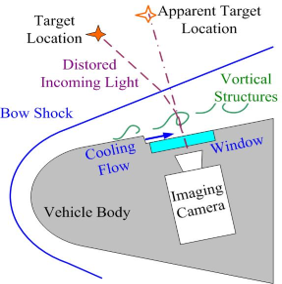
Optics comprise key subsystems for hypersonic vehicles. They are used in targeting and communications and have the potential to be applied to directed energy (or laser) systems. Aaron Fassler's research concerns optical window performance in hypersonic conditions. To weather the extreme temperatures of hypersonic flow, an optical window may be cooled by blowing another gas (nitrogen, e.g.) across it. This, however, creates a mixing layer that produces high levels of optical distortion. Through use of Schlieren and Shack-Hartman Wavefront Sensor (SHWFS) measurement techniques, Aaron's research aims to produce a better model for aero-optical distortions in these kind of mixing layers.
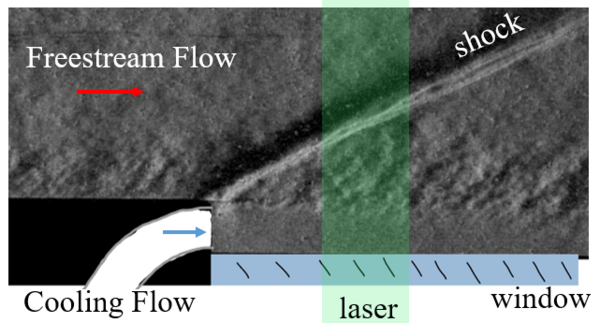
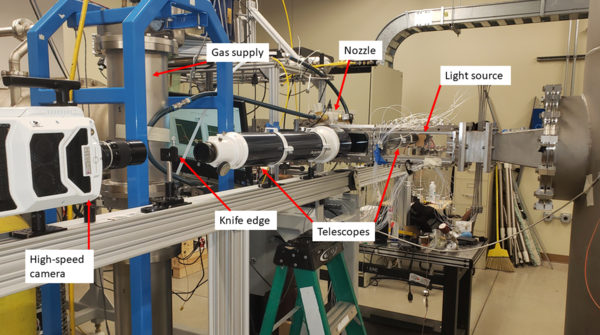
Wind tunnel with the Schlieren system setup.
Aaron Fassler, Sergey Leonov, Stanislav Gordeyev, "Optical effects of a temperature-mismatched supersonic mixing layer," Proc. SPIE 12693, Unconventional Imaging, Sensing, and Adaptive Optics 2023, 1269316 (3 October 2023); https://doi.org/10.1117/12.2677429
Boundary Layer Transition Effects
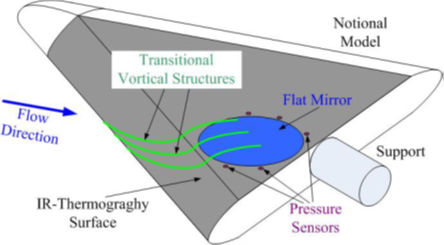
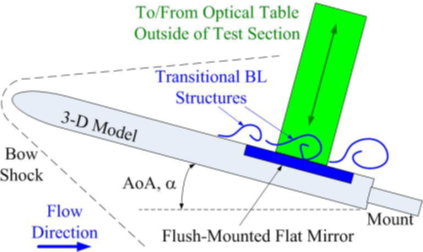
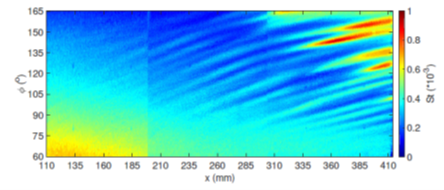
A joint experimental and numerical investigation of the aero-optical and fluidic environment of the vortical structures on the surface of a “slab delta” test model, which resembles the nose of a notional hypersonic vehicle.
The objective of the research is to quantify the aero-optical distortions due to instability-related vortical structures at various stages of their development.
The results will be used to provide much needed models and guidelines for designing effective imaging and tracking systems with acceptable aero-optical distortions for a variety of hypersonic vehicles.
CFD
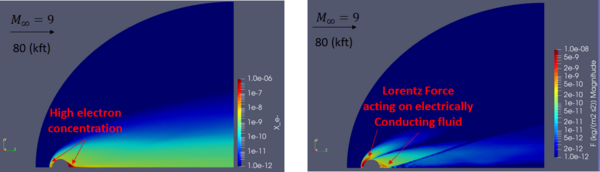
Hypersonic vehicles generate intense heat, partially ionizing the surrounding air into a plasma of ions and electrons, creating complex interactions between fluid dynamics and electromagnetic wave propagation. Traditional aero-optics focuses on density fluctuations, but hypersonic flow introduces additional challenges, including chemical reactions, vibrational non-equilibrium, and ionization, all of which can disrupt electromagnetic waves. By integrating Maxwell’s equations into advanced hypersonic flow models, this research aims to improve our understanding of these coupled effects. The findings will inform engineering advancements in aero-optical systems, ensuring high-performance operation in the extreme conditions of hypersonic flight.
The figures below show some of our early simulations showing electron concentrations, Lorenz force on an electrically conducting hypersonic flow, and a vibrational nonequilibrium indicator for the flow field around a 2D cylinder.